The Ishëm River is born in Kruja. Its depollution must start there too.
The two confluences that form the Ishëm River, at Larushk and Bilaj, both lie within the Municipality of Kruja. Every tonne of waste dumped on the banks of the Zeza and Tërkuza rivers eventually travels towards the Adriatic. RESU’s new report, “Depollution of the Ishëm River in Kruja”, shows where this waste lies, how much risk it poses, and how it can be removed for good.
What we found
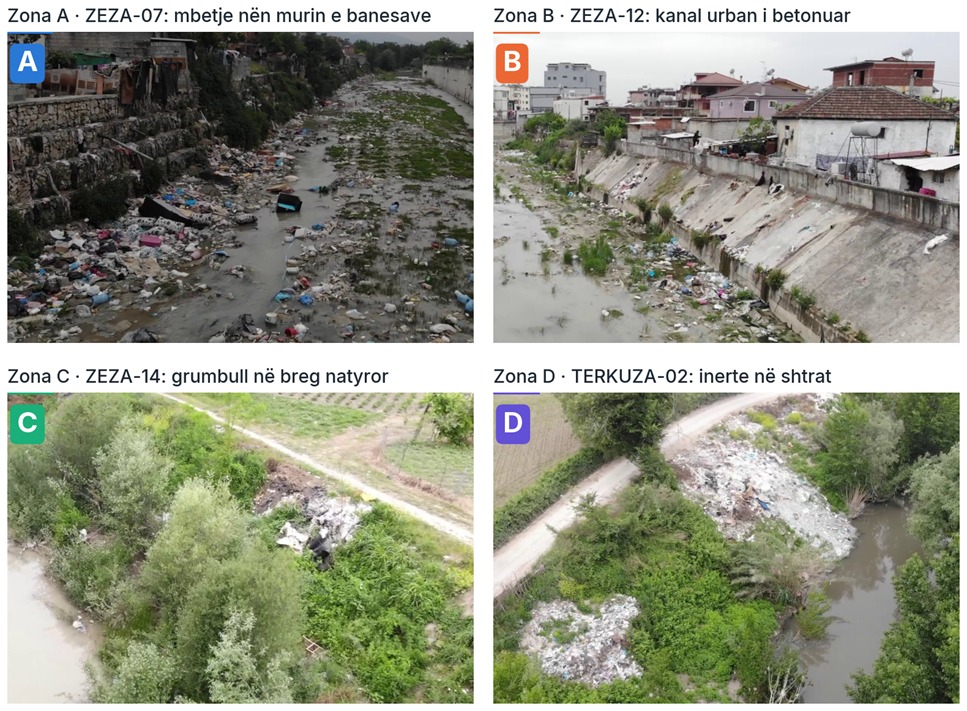
In April 2026, the RESU team surveyed the Zeza (Fushë-Kruja) and Tërkuza (Nikël) rivers by drone and verified the findings in the field. The result is a GIS inventory of 16 source sites and a 1.32 km stretch of waste scattered by the current.
- 13 of the 16 sites lie inside the riverbed or channel, and all of them are less than 10 metres from the water.
- 13 sites are less than 10 metres from homes.
- 8 sites show traces of open burning, so the pollution also affects the air residents breathe.
- In a single zone, 11 sites are packed into just 318 metres of river.
Why it matters
The Ishëm basin collects water from more than one million people in Tirana, Kamza, Vora, Kruja and Durrës. According to RESU’s estimate, it carries around 503 tonnes of plastic to the sea every year. Cleaning up Kruja is not just a local matter: it is the first step towards a cleaner river all the way to the Adriatic.
What we propose
The report goes beyond diagnosis. For every site, it sets out a concrete closure and rehabilitation plan:
- removing the waste, separating it for recycling, and sending it only to permitted sites;
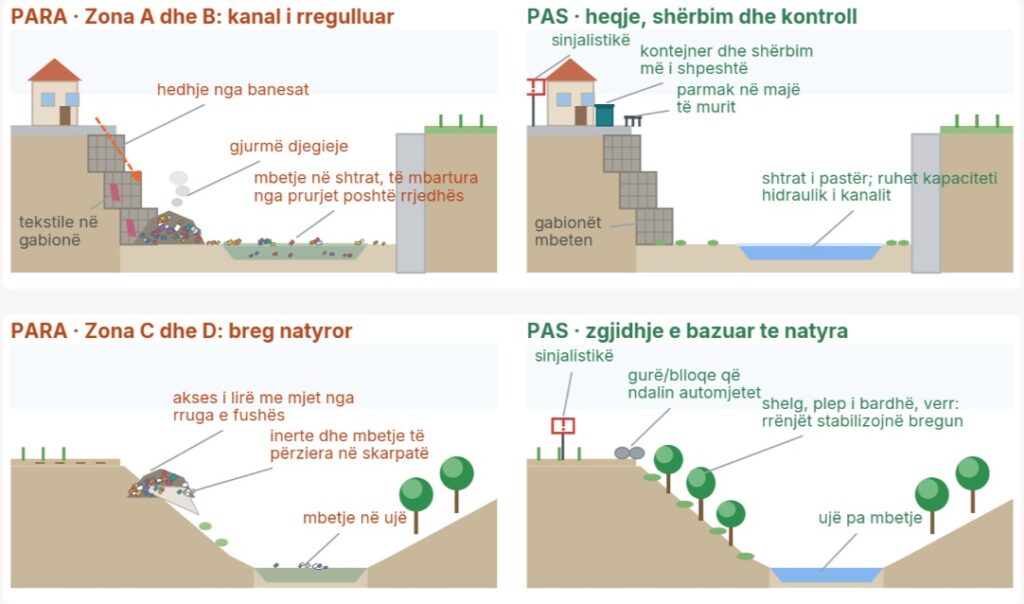
- restoring the riverbanks: controls along the concrete channels, and native vegetation such as willow, white poplar and alder on the natural banks;
- prevention measures that tackle the root causes: bins, barriers, enforcement and community involvement;
- implementation within 3 months, with monitoring after 3, 6 and 12 months against measurable indicators.
Part of the Green Agenda
The plan turns the depollution pillar of the Green Agenda for the Western Balkans into concrete action on the ground. It also addresses the requirements of Chapter 27 on the environment, which Albania is negotiating with the European Union. It builds on the MELI project’s 2022 work in Kamza. The report also proposes a shared register of polluted sites for the entire Ishëm basin.
👉 Download the full report (PDF). Inside you’ll find a fact sheet for every site, with photos, coordinates and proposed measures.
This report was produced under the MELI 2.0 project – Metamorphosis of the Ishëm River, co-funded by the European Union [add the programme or partner, e.g. Belgrade Open School]. This publication was produced with the financial support of the European Union. Its contents are the sole responsibility of RESU – Reinforce Sustainability and do not necessarily reflect the views of the European Union.